EU-based & Open-Source Alternatives to Azure (2026)
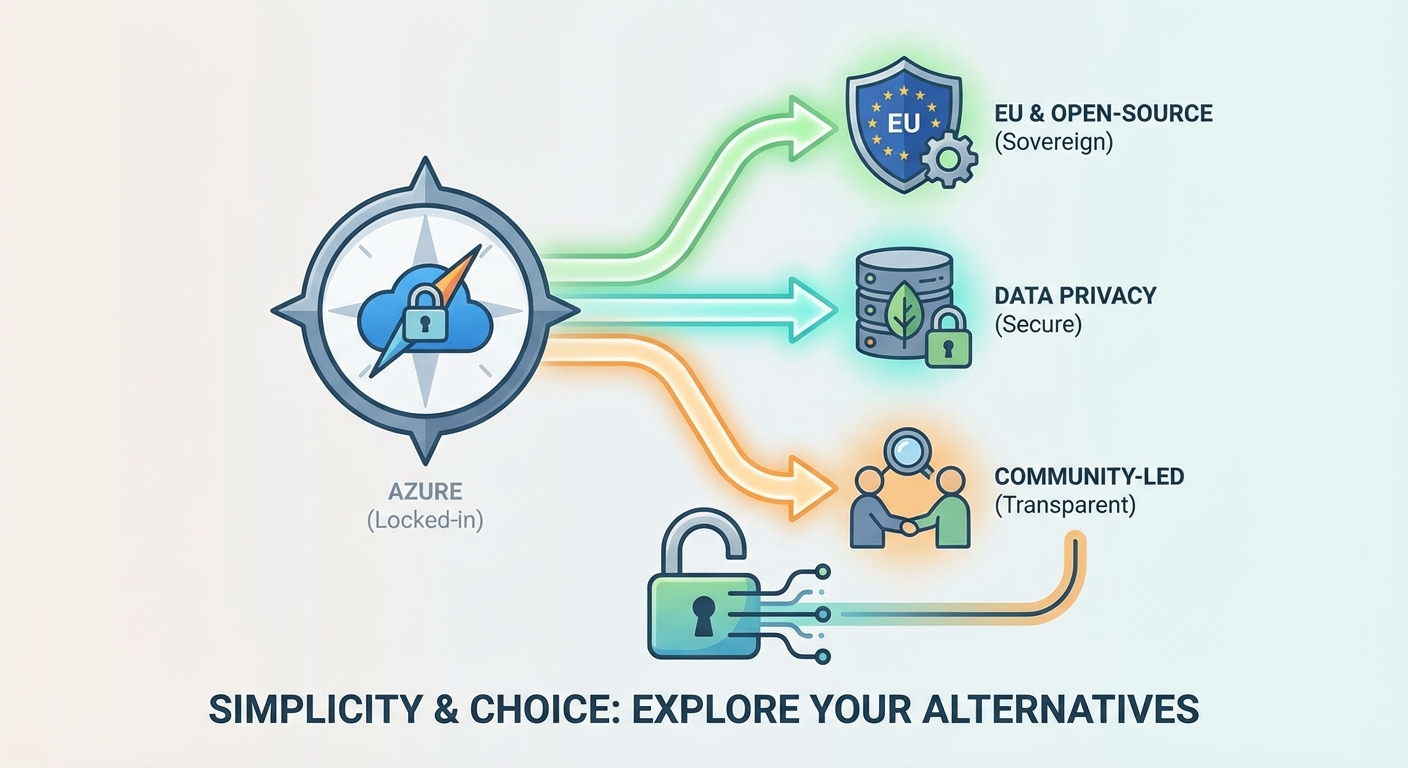
This guide is for European businesses that want to migrate away from Microsoft Azure for sovereignty, compliance, or cost reasons. We focus on EU-based cloud providers, self-hosted/open-source alternatives, and tools that let you avoid US jurisdiction entirely.
Why this matters: Azure is a US company, subject to US laws (e.g., CLOUD Act, FISA). Even its "EU regions" can route data through US servers. The alternatives below let you keep data in the EU, self-host, or use open-source tools to avoid vendor lock-in.
Table of Contents
TL;DR: Top Azure Alternatives
| Provider | Best For | Key Features | Hosting | Open-Source? |
|---|---|---|---|---|
| STACKIT | Enterprise, Germany/EU focus, Schwarz Group (Lidl) backing | GDPR-compliant, German data centers, Kubernetes, AI/ML tools, direct peering with AWS/Azure for hybrid setups | EU (Germany) | ❌ |
| OVHcloud | SMEs, startups, privacy-focused orgs | French/EU-owned, no US jurisdiction, bare metal + cloud, anti-DMA stance, carbon-neutral | EU (France/DE/PL) | ❌ |
| Hetzner Cloud | Developers, cost-sensitive projects, open-source fans | German-owned, transparent pricing, no hidden fees, EU-only data centers, great for Kubernetes | EU (Germany/Finland) | ❌ |
| Ionos (by United Internet) | SMEs, WordPress, managed services | German-owned, EU data centers, managed Kubernetes, WordPress hosting, GDPR-compliant | EU (Germany/UK/Spain) | ❌ |
| UpCloud | High availability, global EU presence | Finnish-owned, 100% uptime SLA, EU/UK/Singapore regions, MaxIOPS storage, GDPR-compliant | EU (DE/UK/FI/NL) | ❌ |
| OpenTelekomCloud | Enterprise, hybrid cloud, telecom integrations | German telecom-backed, EU data centers, SAP-certified, high compliance (ISO 27001, C5) | EU (Germany) | ❌ |
| CityCloud (by CityNetwork) | Nordic focus, sustainability | Swedish-owned, EU data centers, carbon-negative, OpenStack-based, GDPR-compliant | EU (Sweden/DE) | ❌ |
| Scaleway | Developers, startups, bare metal | French-owned, EU data centers, ARM servers, Kubernetes, serverless, transparent pricing | EU (France/NL/PL) | ❌ |
| Aruba Cloud | Italian market, SMEs, managed services | Italian-owned, EU data centers, GDPR-compliant, managed services, object storage | EU (Italy/Czech/DE/FR) | ❌ |
| T-Systems (Deutsche Telekom) | Enterprise, hybrid cloud, telecom integrations | German telecom-backed, EU data centers, Open Telekom Cloud, high compliance, SAP-certified | EU (Germany) | ❌ |
| Self-Hosted (OpenStack) | Full sovereignty, custom needs | Open-source cloud platform, host on EU bare metal (e.g., Hetzner, OVH), no vendor lock-in | Self-Hosted (EU) | ✅ |
| Self-Hosted (Kubernetes + EU PSPs) | Cloud-native, containerized workloads | Run Kubernetes on EU bare metal (e.g., Hetzner, OVH), integrate with EU payment/storage (e.g., bunq, STACKIT) | Self-Hosted (EU) | ✅ |
Why Ditch Azure?
1. Data Sovereignty & Compliance
Azure is a US company, and even its "EU regions" have risks:
- CLOUD Act: US government can access your EU customer data.
- FISA 702: NSA can surveil data in transit (e.g., Azure’s global network).
- Schrems II: EU-US data transfers require SCCs (Standard Contractual Clauses), which are legally shaky.
- Audit headaches: Proving "no US data exposure" is nearly impossible with Azure.
EU alternatives are EU-owned and host data in EU jurisdictions (e.g., Germany, France), so they’re not subject to US laws.
2. Cost & Vendor Lock-in
Azure’s pricing is opaque and locks you in:
- Egress fees: Charges for moving data out of Azure.
- Hidden costs: Reserved instances, support plans, and "enterprise discounts" that vanish.
- No price parity: EU regions often cost more than US regions.
EU providers offer:
- Transparent pricing (e.g., Hetzner, Scaleway).
- No egress fees (e.g., OVHcloud, STACKIT).
- Local support (no US time zones or outsourced helpdesks).
3. Self-Hosting = Full Control
Self-hosting (e.g., OpenStack, Kubernetes) lets you:
- Host on EU bare metal (e.g., Hetzner, OVH).
- Avoid US cloud providers entirely.
- Integrate with EU payment providers (e.g., bunq, Adyen).
- Customize security, compliance, and cost to your needs.
Categories of Alternatives
1. EU-Managed Cloud
Pros: No US jurisdiction GDPR-compliant by default Local support (EU time zones) Transparent pricing
Cons: Fewer "global" regions Smaller ecosystems than Azure
Best for: SMEs, enterprises, or teams that want a drop-in replacement for Azure without self-hosting.
2. Self-Hosted (Open-Source)
Pros: Full data control No vendor lock-in Customize security/compliance Lower long-term costs
Cons: Technical setup Maintenance burden PCI DSS/ISO 27001 compliance is your responsibility
Best for: Tech teams, high-compliance needs (e.g., healthcare, government), or businesses that want to avoid US cloud providers entirely.
3. Hybrid (EU Cloud + Self-Hosted)
Some providers (e.g., STACKIT, OpenTelekomCloud) let you:
- Use their EU-managed cloud for most workloads.
- Self-host sensitive components (e.g., databases, payment processing).
- Integrate with EU payment providers (e.g., Adyen, Mollie).
Top Providers in Depth
1. STACKIT (by Schwarz Group, owners of Lidl)
Best for: Enterprise, Germany/EU focus, hybrid cloud.
Why?
- German-owned, EU data centers (no US exposure).
- Backed by Schwarz Group (Lidl, Kaufland), so it’s financially stable.
- Direct peering with AWS/Azure for hybrid setups.
- Kubernetes, AI/ML, and SAP-certified services.
- GDPR-compliant by default.
Limitations:
- Less "global" reach than Azure (only EU regions).
- Smaller ecosystem (fewer third-party integrations).
Pricing: Competitive with Azure, but no egress fees.
Use STACKIT if: ✅ You’re a German/EU enterprise needing compliance and hybrid cloud. ✅ You want Lidl-level reliability without US risks.
2. OVHcloud (France)
Best for: SMEs, startups, privacy-focused organizations.
Why?
- French-owned, no US jurisdiction.
- Anti-DMA stance (fights US tech dominance).
- Bare metal + cloud options.
- Carbon-neutral data centers.
- Transparent pricing (no hidden fees).
Limitations:
- Smaller global footprint (mostly EU regions).
- Less "enterprise" polish than Azure.
Pricing: Cheaper than Azure for equivalent resources.
Use OVHcloud if: ✅ You want a privacy-first, EU-owned cloud. ✅ You need bare metal + cloud flexibility.
3. Hetzner Cloud (Germany)
Best for: Developers, cost-sensitive projects, open-source fans.
Why?
- German-owned, EU-only data centers.
- Transparent pricing (no surprises).
- Great for Kubernetes (managed and unmanaged).
- No vendor lock-in (easy to migrate away).
Limitations:
- Fewer managed services than Azure.
- Smaller global footprint (EU + US, but US is optional).
Pricing: ~50% cheaper than Azure for equivalent VMs.
Use Hetzner if: ✅ You’re a developer who wants simple, cheap, EU-only cloud. ✅ You need Kubernetes without US exposure.
4. Self-Hosted OpenStack (EU)
Best for: Full sovereignty, custom needs, avoiding vendor lock-in.
Why?
- 100% EU-hosted (e.g., on Hetzner/OVH bare metal).
- No US exposure (data stays in your EU data center).
- Open-source (no licensing fees).
- Customize everything (security, compliance, integrations).
Limitations:
- Technical setup (requires OpenStack expertise).
- Maintenance burden (updates, security patches).
- PCI DSS/ISO 27001 compliance is your responsibility.
Cost: ~€1,000–€5,000/month (bare metal + dev time).
Use OpenStack if: ✅ You need zero US data exposure. ✅ You have dev resources for setup/maintenance. ✅ You want to avoid cloud vendor lock-in.
5. Ionos (by United Internet)
Best for: SMEs, WordPress, managed services.
Why?
- German-owned, EU data centers.
- Managed Kubernetes and WordPress hosting.
- GDPR-compliant by default.
- Good for smaller businesses that want simplicity.
Limitations:
- Less scalable than Azure for large workloads.
- Fewer advanced services (e.g., AI/ML).
Pricing: Competitive for SMEs, but not as cheap as Hetzner.
Use Ionos if: ✅ You’re an SME that wants managed services (e.g., WordPress, Kubernetes). ✅ You need German-owned, EU-hosted cloud.
How to Migrate from Azure
Step 1: Audit Your Workloads
- List all Azure services you use (e.g., VMs, Kubernetes, databases).
- Identify compliance requirements (e.g., GDPR, ISO 27001).
- Estimate data volume (affects migration time/cost).
Step 2: Choose a Strategy
Pick one:
- Lift-and-shift: Move VMs/containers to an EU provider (e.g., STACKIT, OVHcloud).
- Refactor: Rebuild apps for open-source (e.g., Kubernetes + EU databases).
- Hybrid: Keep some workloads on Azure (e.g., global CDN) but move sensitive data to EU.
Step 3: Test & Pilot
- Set up a test environment with your top 2–3 EU providers.
- Migrate a non-critical workload first (e.g., staging, dev).
- Check for performance issues (latency, compatibility).
Step 4: Migrate
- Use automated tools (e.g., Terraform, Velero for Kubernetes).
- Schedule downtime for critical workloads.
- Monitor for data consistency and errors.
Step 5: Optimize
- Right-size resources (EU providers often have better pricing).
- Set up EU-only backups (e.g., OVHcloud Object Storage).
- Train your team on the new provider’s tools.
Common Pitfalls & How to Avoid Them
| Pitfall | Solution |
|---|---|
| Hidden US data routing | Ask providers for a Data Processing Agreement (DPA) and check sub-processors. |
| Downtime during migration | Use blue-green deployments or migrate in phases. |
| Compliance gaps | Work with a GDPR/ISO 27001 consultant (e.g., Lieu) to audit the new setup. |
| Vendor lock-in with EU providers | Use open standards (e.g., Kubernetes, OpenStack) to stay portable. |
| Performance issues | Test latency between your EU data center and users. |
| Missing Azure features | Replace proprietary services with open-source (e.g., Kubernetes for AKS, PostgreSQL for Azure SQL). |
Final Recommendations
For most EU businesses:
- Start with STACKIT or OVHcloud (easy migration, EU-owned).
- Use Hetzner if you’re cost-sensitive or need Kubernetes.
- Avoid US providers unless absolutely necessary (e.g., global CDN).
For high-compliance needs (e.g., healthcare, government):
- Self-host OpenStack/Kubernetes on EU bare metal (e.g., Hetzner, OVH).
- Use STACKIT or OpenTelekomCloud if you need managed services.
For developers:
- Try Hetzner Cloud or Scaleway for cheap, EU-only hosting.
- Use Kubernetes to avoid lock-in (works on any EU provider).
Next Steps with Lieu
We help businesses migrate from Azure to sovereign EU alternatives. Here’s how we can assist:
- Audit: We’ll analyze your Azure usage and pick the best EU alternative.
- Pilot: Set up a test environment with your top 2–3 options.
- Migrate: Handle data export, security setup, and compliance checks.
- Optimize: Reduce costs, improve performance, and ensure GDPR compliance.
Profit sharing: We’ll use revenue from consulting to fund new EU cloud tools (e.g., missing integrations, open-source contributions).
Book a consultation to get started.